For most homeowners 62 and older, the house is the single largest source of savings they have. A Home Equity Conversion Mortgage (HECM), commonly called a reverse mortgage, lets you convert a portion of that equity into cash, a line of credit, or monthly advances, without taking on a required monthly mortgage payment. This page walks through how it actually works, in plain English, so you and your family can have an informed conversation before deciding anything.
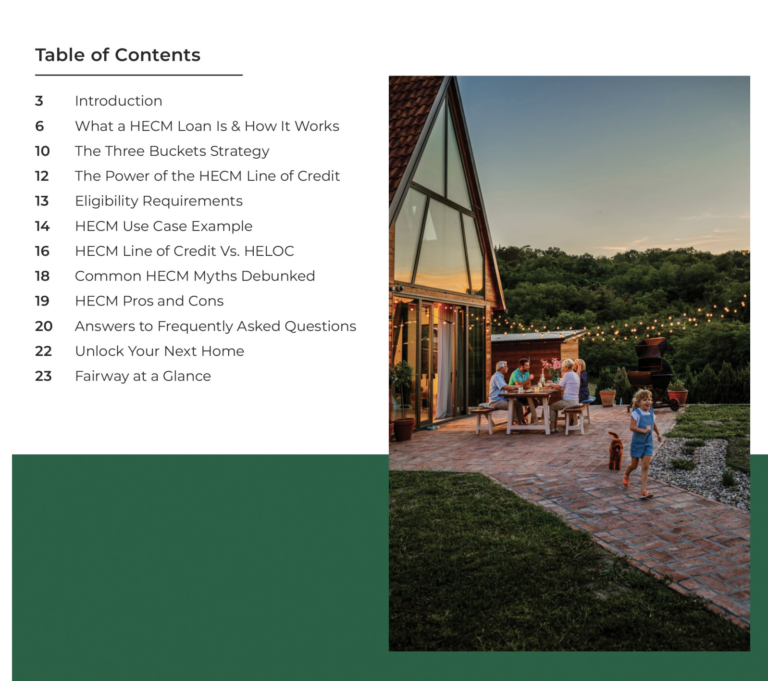
Send download link to:
We never sell your information. By entering your email you agree to receive the requested guide and occasional follow-up from Ken Powell and Fairway Independent Mortgage Corporation. Consent is not required to use our services. See our privacy policy.
Fairway Independent Mortgage Corporation, National Recognition
These are national recognitions earned by Fairway Independent Mortgage Corporation (NMLS #2289), Ken's lender, not an individual award given to Ken Powell. Source: fairwayreverse.com.
A HECM lets you access a percentage of your home equity as a single lump sum, fixed monthly advances for a set number of months or for life, a line of credit, or a combination, without a required monthly mortgage payment. You must still live in the home and pay property taxes and insurance. Proceeds are generally not subject to income tax and can be used for any purpose.
A HECM is not free money, interest and fees accrue on the balance, but you can pay as much or as little toward it each month as you like, including nothing. Most borrowers choose not to make a monthly payment. Where a traditional mortgage moves money from you to the lender every month, a HECM typically moves the other way: the lender advances funds to you.
When the loan becomes due and is satisfied by selling the home, the FHA guarantees that neither you nor your heirs will ever be personally liable for a balance that exceeds what the home sells for. This is the loan's non-recourse feature, and it applies to every HECM.
A maturity event, most often the death of the last surviving borrower, a permanent move out, or the sale of the property, triggers the loan to become due and payable. Here is what happens next, in plain terms:
They can sell it on the open market and keep any profit above the loan balance (with up to six months, sometimes extended by HUD, to do so), or sign a deed-in-lieu of foreclosure and hand the home to the lender without owing the difference and without it affecting their credit.
They can pay off or refinance the balance if it's less than the home's value, or pay the lesser of the full loan balance or 95 percent of the home's appraised value, often by taking out a new mortgage on the home.
A non-borrowing spouse who still lives in the home after the last borrower dies may, under HUD rules, be able to remain and defer repayment during what's called the deferral period, as long as they keep paying property taxes and insurance.
Fact: When you permanently move out, whether by selling or passing away, neither you, your estate, nor your heirs are responsible for any deficit if the balance exceeds the home's value. If your heirs want to keep the home, they can pay the lesser of the loan balance or 95 percent of its appraised value.
Fact: The deed stays in your name. As long as you pay your property taxes, insurance, and maintain the home, you cannot be foreclosed on for the term of the loan, and you remain free to move or sell whenever you choose.
Fact: In the event of an extended nursing home stay or an unexpected expense, you could end up needing equity you otherwise can't easily reach. A HECM can unlock that equity for your benefit while you're still able to use it.
Fact: Upfront costs can be higher than a traditional mortgage, and almost all of them, including closing costs and ongoing fees, can be rolled into the loan. In exchange you get no required monthly payment, a growing line-of-credit option, and the FHA-insured non-recourse guarantee.
Yes. The deed stays in your name and you remain on title. You can move, sell, or refinance whenever you choose, exactly as with any mortgage, as long as you keep up with your property taxes, homeowners insurance, and maintenance.
No. A HECM is a non-recourse loan, which the FHA guarantees. If the loan balance ends up higher than the home is worth when it's sold, neither you nor your heirs are ever personally responsible for the difference.
No monthly principal and interest payment is required for as long as you live in the home as your primary residence, maintain it, and pay the property-related taxes, insurance, and any HOA dues. Most borrowers choose to make no monthly payment at all.
The loan becomes due and payable when the last surviving borrower permanently leaves the home, most commonly by passing away or moving out. It is typically satisfied by selling the home. If the sale proceeds exceed the balance, you or your heirs keep the difference. If they don't, the FHA's insurance covers the shortfall, not you or your family.
No. Every HECM borrower must complete an independent counseling session with a HUD-approved counselor before applying, to confirm the loan is understood and is a good fit. This page and the downloadable guide are educational and do not replace that session.
No, that's one of the more persistent myths. Increasingly, financial advisors view a HECM line of credit as a proactive retirement-planning tool, not a last resort. Used earlier in retirement, it can create cash flow flexibility and help a portfolio last longer, not just rescue a household that has run out of options.
That is a personal choice, but many homeowners benefit from involving trusted family members, a financial advisor, or an attorney before deciding, since the loan affects what happens to the home down the road.
When you're ready, schedule an educational conversation with Ken to see what your own numbers look like and compare a reverse mortgage with other realistic options.